
EPA Section 608 Refrigerant Rules, Explained for Berkeley
Elsewhere on this site we tell you to ask any technician for documentation before refrigerant work begins — and that we would rather show paperwork than print a badge. This page is that paperwork, explained. The rule governing every refrigerant decision in your kitchen is Section 608 of the Clean Air Act, carried out through EPA regulations at 40 CFR Part 82, Subpart F. In plain terms: anyone whose work could open the refrigerant circuit of your Sub-Zero — attaching gauges, cutting a line, swapping a compressor — must hold EPA Section 608 certification, and the refrigerant inside must be recovered, not released. Our technicians hold the Universal version of that credential, the broadest of the four EPA defines. What follows is the Berkeley owner's version of the rule: where it came from, which refrigerant your Sub-Zero era carries, what changes the moment a sealed system is opened in an Elmwood or Northbrae kitchen, and how to check a card yourself.
How a refrigerator repair became federal law
Section 608 did not appear out of nowhere. It is the domestic half of an international repair job on the atmosphere, and the timeline is short enough to read over coffee:
- 1987
The Montreal Protocol
Nations agree to phase out CFCs — the chlorine-bearing refrigerants found to be thinning the ozone layer. R-12, the refrigerant inside pre-1994 Sub-Zero models, is exactly this kind of chemical.
- 1990
Congress amends the Clean Air Act
Section 608 is written into U.S. law, directing EPA to build a refrigerant-management program: recovery requirements, certified technicians and approved recovery equipment.
- 1992
The venting ban takes effect
From July 1, 1992, knowingly releasing CFC or HCFC refrigerant while servicing or scrapping an appliance becomes unlawful. In the early 1990s, EPA also begins approving certifying organizations to test technicians — ESCO Institute among the first.
- 1995
Substitutes join the ban
From November 15, 1995, the prohibition extends to substitute refrigerants. That is what makes R-134a — the working fluid in most Berkeley Sub-Zeros — a recover-don't-release substance to this day.
- 2010s
Hydrocarbons get a carve-out
EPA approves isobutane (R-600a) for household refrigerators and exempts it, in that specific use, from the venting prohibition — a nod to its tiny climate footprint, though its flammability brings a handling discipline of its own.
- 2021
Sub-Zero's lineup turns the corner
The refrigeration Sub-Zero brought out from 2021 onward runs on R-600a, joining the PRO 36 and PRO 48, which already used it.
Which refrigerant is behind your grille? Sub-Zero by era
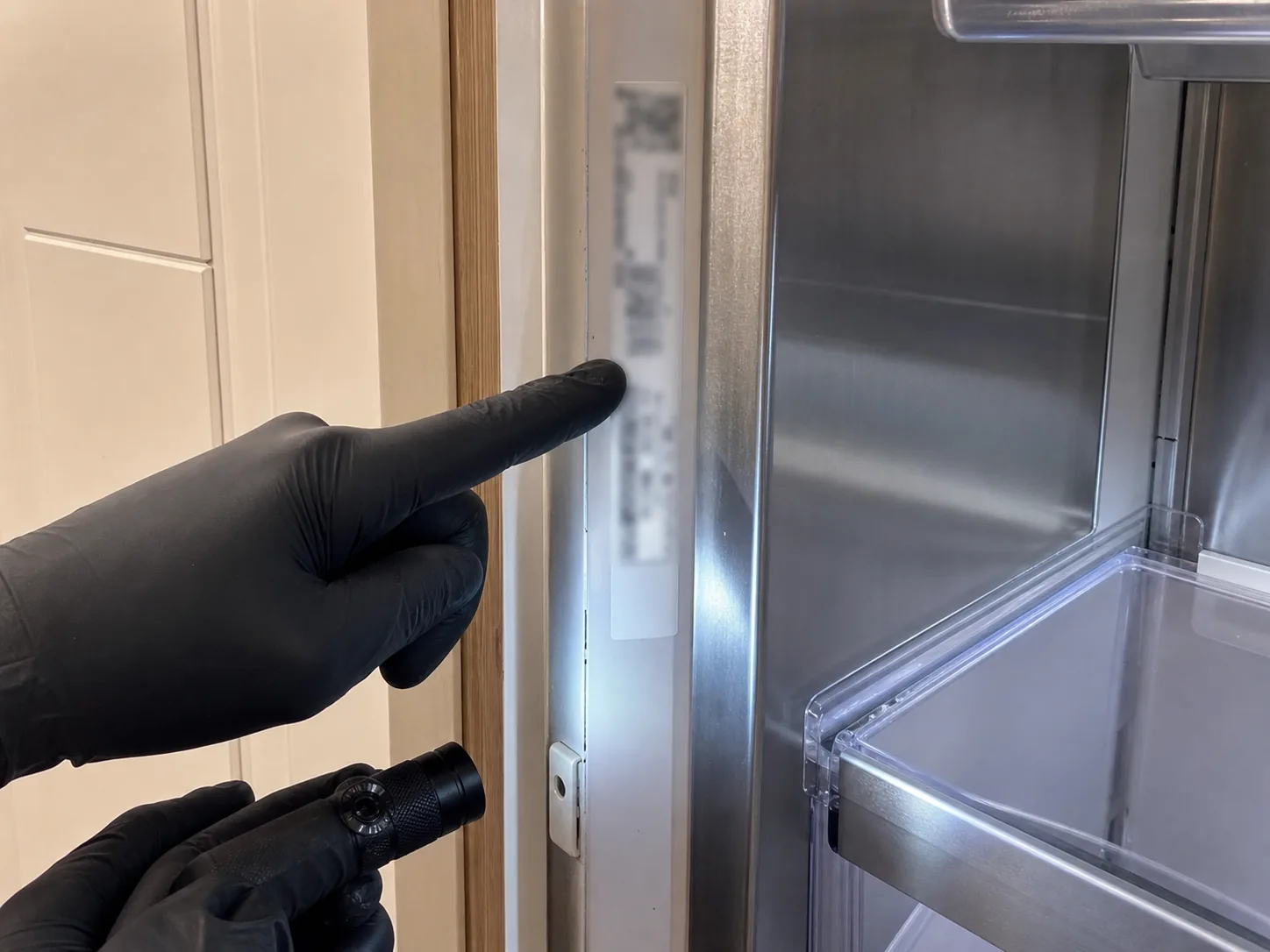
The rulebook lands differently depending on what is circulating in your unit, and Sub-Zero has used three refrigerants across its production history. Find your era below — then confirm it, because the serial plate on your own cabinet states the exact refrigerant and charge. The model & serial number guide shows where that plate hides on each series.
| Sub-Zero era / models | Refrigerant | Chemical family | On a Berkeley service call |
|---|---|---|---|
| Built before 1994 | R-12 | CFC — ozone-depleting | Subject to the venting prohibition (effective July 1, 1992 for CFC and HCFC refrigerants). Recovery with certified equipment required; refrigerant handling restricted to Section 608-certified technicians. Few units remain in service. |
| 1994 onward — classic 500/600/700 and most BI-series cabinets | R-134a | HFC — a potent greenhouse gas | Subject to the venting prohibition as a substitute refrigerant (effective November 15, 1995). Recovery to a cylinder required before the circuit is opened; recharge by weight after leak repair. |
| PRO 36 and PRO 48 | R-600a | Hydrocarbon (isobutane) | Exempt from the federal venting prohibition in household refrigerators and freezers. Flammable; recovery with hydrocarbon-rated equipment applied as standard practice rather than federal mandate. |
| 648PRO | R-134a | HFC | R-134a provisions apply notwithstanding the PRO designation: recovery before the circuit is opened, leak repair, recharge by weight. |
| Refrigeration Sub-Zero brought out from 2021 onward | R-600a | Hydrocarbon (isobutane) | Same exemption and handling protocol as other R-600a units: low global warming potential, flammability controls observed, no ignition sources at the work area. |
The chart is the orientation; the plate is the law of your unit. Your Sub-Zero's serial/rating plate lists the refrigerant type and charge for that exact cabinet, and we read it before any refrigerant decision is made — exact charge sizes vary by model and are never assumed from a table.
What Section 608 changes the moment we open your sealed system
EPA's definition of a "technician" turns on a simple test: could the work reasonably be expected to break into the refrigerant circuit? If yes, certification is mandatory. So the person who vacuums dust from your condenser grille does not need a card — the person who connects gauges to your 700-series does. That line runs straight through every sealed-system and compressor call we take in Berkeley.
Procedurally, here is what the rule looks like in a Claremont kitchen. Before a single line is cut, the recovery rig draws the charge into a sealed cylinder, using equipment certified for exactly that job. The only releases federal law tolerates are the "de minimis" wisps that escape during a good-faith recovery — not a shortcut, an allowance for physics. Then comes the actual repair: leak located and brazed, system evacuated, refrigerant recharged by weight to the figure stamped on your serial plate. Each of those steps appears on the invoice, the same way our parts and warranty documentation itemizes everything else.
About the four credentials: EPA defines Type I for small appliances, Type II for high-pressure equipment, Type III for low-pressure equipment, and Universal for all of it. "Small appliance" has a precise meaning — factory-manufactured, hermetically sealed, charged with five pounds or less of refrigerant — and home refrigerators and freezers are named in the definition. Your built-in Sub-Zero is Type I territory; a Universal card, which requires passing the proctored Core exam plus all three type exams, covers that work with room to spare.
The supply chain enforces the rule from the other side, too. Refrigerant for stationary equipment is sold only to Section 608-certified technicians, which is why "just top it off" is not actually an option for a Berkeley homeowner — and why a low charge always means a leak to find, never a fluid to refill. If your fresh-food section is drifting warm, start with the not-cooling evidence page before anyone says the word compressor.
Finally, who actually holds the credential: the individual, never the business. EPA approves certifying organizations — ESCO Institute is one example, the industry's largest — and the organization, not EPA, issues the wallet card. The card does not expire. California adds one separate, business-level layer: appliance repair operations register with the state Bureau of Household Goods and Services, and that registration is public record — BHGS keeps a searchable register of licensees on its website. Two layers, two different questions — and neither one substitutes for the other.
What you can ask for on any Berkeley sealed-system visit
- The Section 608 wallet card — on the card itself, one technician's name appears beside a certification type and an issuing organization.
- Verification through the issuing body — EPA leaves certification records with its approved organizations, so a card is checked through the issuer's own online lookup, such as ESCO's.
- The recovery step itself — refrigerant going into a cylinder before any line opens, and a recharge documented by weight on your invoice.
One honest boundary: Section 608 certifies technicians, not companies — so no business, ours included, can truthfully call itself "EPA-certified." The accurate statement is that the technicians doing refrigerant-circuit work here hold EPA Section 608 Universal certification, shown on request.
The environmental note, for a city that keeps score
Berkeley audits its climate ledger more carefully than most cities its size, so it is a fair question: what does one refrigerator repair have to do with the atmosphere? More than the size of the appliance suggests. Pound for pound, R-134a is a dramatically more powerful warming agent than carbon dioxide — on the order of a thousand times more potent over a century — which is why even the modest charge inside a household unit is worth recovering meticulously instead of letting it drift out over the bay. Recovery is not bureaucratic theater; it is the entire point of the statute.
R-600a, the isobutane in newer Sub-Zero units, sits at the other end of the scale: its global warming potential is a small fraction of R-134a's, in the single digits. That is precisely why EPA exempted it from the venting prohibition in household refrigerators. We treat the exemption as a climate fact, not a shortcut. Isobutane burns, and our procedure stays recovery-first regardless: the charge goes into a cylinder before a line opens, the gear carries a hydrocarbon rating, and ignition sources leave the work area — safety practice, not federal mandate. And for scale: California's CARB refrigerant program pursues facilities whose largest system holds more than 50 pounds of high-GWP refrigerant — supermarket racks and cold storage, not your kitchen. Your built-in sits far below that threshold; the federal technician rule is the one that reaches it.
Questions Berkeley owners ask about the rule
Is the person opening my Sub-Zero's refrigerant loop legally required to hold a Section 608 card?
Yes. The defining language sits in 40 CFR Part 82, Subpart F: a technician is anyone whose maintenance, service or repair work “could be reasonably expected to release refrigerants from appliances,” and that work requires EPA certification. Connecting gauges, recovering or adding refrigerant, cutting a line or replacing a compressor on a Berkeley Sub-Zero all fall squarely inside that definition.
What does a Universal card add over Type I for a household refrigerator?
Type I alone covers small appliances — products factory-sealed with five pounds or less of refrigerant, a definition that explicitly includes home refrigerators and freezers. Universal means the technician has passed the proctored Core exam plus all three type exams, so it covers Type I work and everything beyond it. For a built-in Sub-Zero, Universal is more credential than the job strictly requires — which is the right direction for the margin to run.
Is a do-it-yourself R-134a recharge even legal for a Berkeley owner?
Practically, no. Federal rules control who may purchase the refrigerant at all: R-134a in cans or cylinders for stationary equipment is sold only to Section 608-certified technicians. The DIY premise also fails on physics — a low reading means charge has escaped through a leak, and any refrigerant added without that leak being repaired will follow the same path out.
Do Section 608 credentials lapse if they are never renewed?
No — EPA states plainly that Section 608 technician credentials do not expire, for any of the four types. The regulation sets no renewal cycle at all: certification is issued once by an EPA-approved organization, and 40 CFR Part 82 contains no annual or periodic recertification requirement.
Is releasing R-600a from a newer Sub-Zero treated the same as releasing R-134a?
Not under federal law. EPA has specifically exempted isobutane (R-600a) in household refrigerators and freezers from the venting prohibition, because its climate impact is a small fraction of R-134a's. We still recover it rather than release it indoors, using hydrocarbon-rated equipment — isobutane is flammable, so that discipline is a safety practice we hold ourselves to, not a legal requirement we can cite.
Where does California fit if Section 608 is federal?
California's CARB refrigerant program is aimed at facilities whose largest system holds more than 50 pounds of high-GWP refrigerant — supermarket racks and industrial cold storage, far beyond any household unit. What California does require of an appliance repair operation is business-level registration with the Bureau of Household Goods and Services (BHGS); the bureau maintains a public, searchable list of registrants on its site. The state registers the business; the federal rule certifies the individual technician. Neither replaces the other.
What should I ask to see before sealed-system work starts in my kitchen?
Ask for the Section 608 wallet card, which pairs one technician's name with a certification type and the EPA-approved body that issued the credential — EPA itself does not print the cards. If you want to go further, verification runs through whichever EPA-approved organization issued the card — ESCO Institute, for example, maintains its own online lookup for the credentials it has issued. We consider showing the card on request a normal part of a Berkeley sealed-system visit, not an insult.
Ask the refrigerant questions out loud
If your Sub-Zero is warming and you suspect the sealed system, call and put these questions to us directly — which refrigerant your era carries, what the recovery step involves, what the card says and who issued it. You will get the regulatory answer and the repair answer in the same conversation, before you approve anything.
Pages this explainer backs up
Sealed System & Compressor
The diagnostic matrix, verification steps and Berkeley price ranges for the work Section 608 governs.
TrustParts & Warranty
How refrigerant steps, OEM parts and warranty terms are itemized on the invoice you keep.
GuideModel & Serial Guide
Where to find the rating plate that names your unit's exact refrigerant and charge.
Not sure the sealed system is even the problem? Start with the main Sub-Zero repair page or send your model tag and symptoms and we will route you honestly.
Local dispatch reference: 1935 Addison St, Suite A, Berkeley, CA 94704. Appointments are arranged by phone or online booking.