Skip to content
Berkeley & East Bay · independent Sub-Zero service Call (510) 390-9712Book Online
Berkeley & East Bay Sub-Zero specialists Evidence-first diagnostics, same-day routing when available, and factory-authorized Sub-Zero OEM parts when replacement parts are required. Local dispatch reference
Berkeley Sub-Zero Repair
Sub-Zero repair · Berkeley
Wine storage fault · Berkeley & the East Bay

Sub-Zero Wine Cooler Warm or Not Cooling in Berkeley

When a wine column drifts warm or a dual-zone loses one zone, the cause is usually fixable — and worth catching fast. Here is how the fault is diagnosed before a cellar's worth of bottles pays the price.

4.9/5 · 1,301 verified customer reviews

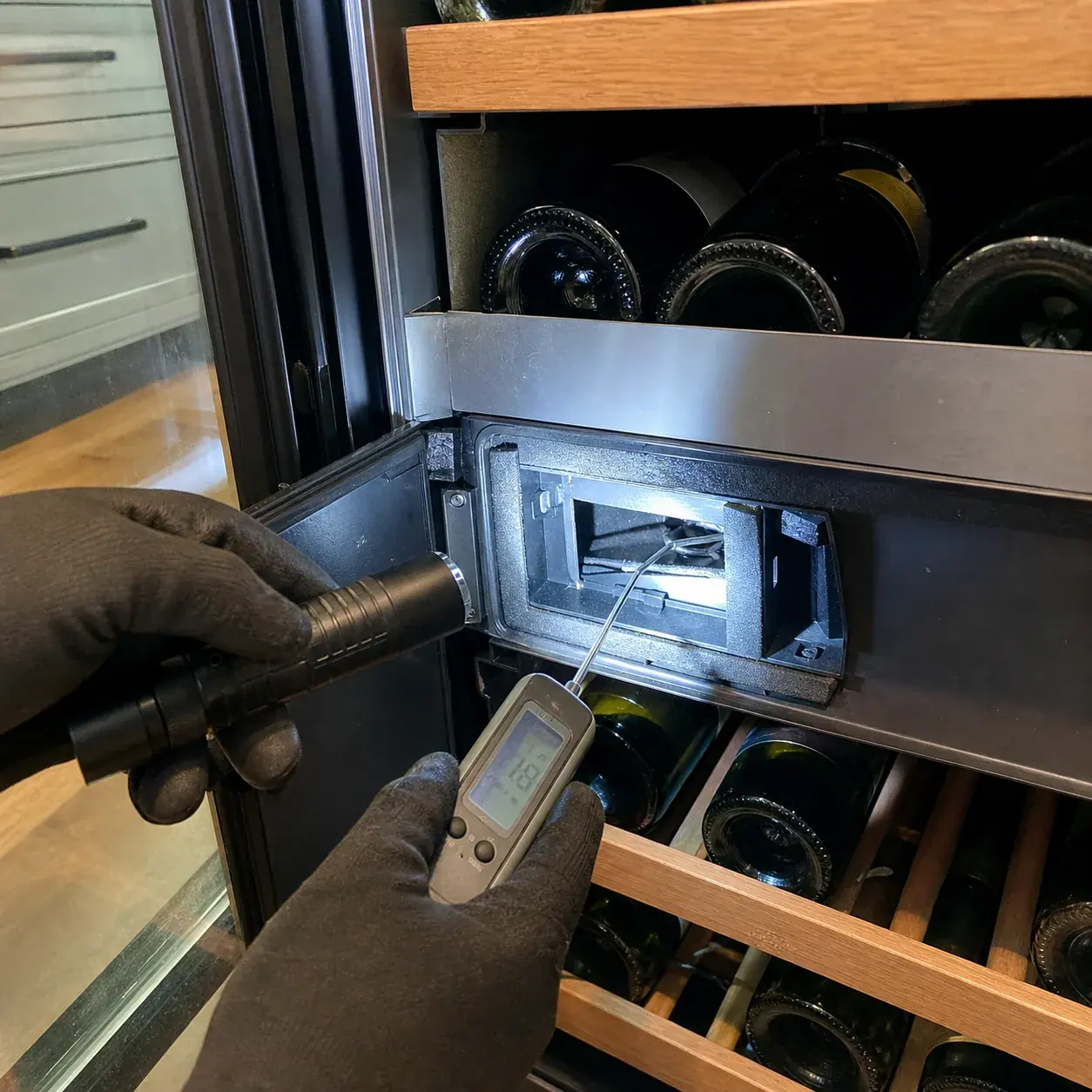
Technician probing the damper and zone temperature of a Sub-Zero wine column in a Berkeley home

Berkeley keeps more serious wine than its size would suggest. Two of the country's most influential merchants — Kermit Lynch on San Pablo and North Berkeley Wine — have trained a generation of local palates, and the result is a town full of built-in Sub-Zero wine columns in the Elmwood, in the leafy streets below the Claremont, and in the hill homes off Euclid and Grizzly Peak. When one of those columns stops holding temperature, the problem is rarely that it has died outright. Far more often it is drifting — and drift is the dangerous kind of failure, because it is silent.

This is where Berkeley's gentle climate works against the collector. There is no blistering inland afternoon to make a warm cabinet obvious; the marine-tempered air outside is so even that a column quietly settling at 62°F instead of 55°F gives nothing away. Weeks pass, the corks soften, and the first sign is a bottle that should have been singing and instead falls flat. Diagnosing this fault is about catching the drift and tracing which part stopped pulling its weight — not waiting for a dramatic warm cabinet.

Why a column drifts warm

The faults behind a warm zone

One zone warm on a dual-zone

When the upper or lower zone alone runs warm while the other is fine, the cooling system is clearly working — so the fault is in that zone's control: a thermistor reading wrong, a damper that will not open, or a board biasing the airflow away from it.

A choked or starved condenser

A wine column rejects its heat through the top grille like the refrigerators do. Dust, cork crumbs, and cabinetry that strangles the airflow leave the coil unable to shed heat, so both zones slowly climb no matter how low you set them.

Door seal and a door left ajar

Glass wine doors are heavy and sometimes loaded with a full rack. A gasket that has hardened, or a door the rack keeps from latching, lets a steady creep of warm room air in — small, constant, and enough to defeat the compressor over time.

Thermistor or control fault

The column trusts its temperature sensors. A drifting thermistor can tell the control the zone is colder than it really is, so the system stops cooling early and the wine sits warmer than the display claims — which is why we measure the bottles, not the panel.

Sealed system or compressor

If both zones go warm together, the coil is clean, and the seals are good, attention turns to the sealed system — a refrigerant or compressor issue. Less common on wine units than fridges, but it is the diagnosis of last resort and needs EPA-handled work.

Overloading and warm bottle loads

Sliding in two cases straight from a warm car trunk asks a small compressor to pull a lot of heat at once, and the display can read high for a day. Real, lasting drift after the load settles is the version that needs a technician.

Step by step

Reset & verify both zones

Before you assume the worst, run this sequence. It separates a set-point or airflow problem you can solve from an internal fault that needs us.

  1. Read both zones with a real thermometer. Put a bottle-probe or a glass of water with a thermometer in each zone overnight. The column's own display can be a degree or two optimistic; you want the actual liquid temperature your wine is living at.
  2. Confirm the set points and clear an alarm. Open the control menu and check each zone is set where you want it — commonly a reds zone in the upper 50s and a whites or service zone in the mid-40s. If a high-temp alarm is showing, acknowledge it and note the code; it tells us how far and how long the drift has run.
  3. Give the condenser a clean and breathing room. Pull the top grille and clear the condenser of dust and cork debris, then make sure nothing in the cabinetry is choking its airflow. A wine column packed into tight Elmwood millwork sheds heat poorly when the coil is matted.
  4. Inspect the door seal and the closing swing. Run a finger around the gasket for hard spots or gaps, and watch the door fall shut on its own. A wine door left ajar by a heavy glass rack, or a tired seal, lets warm room air defeat the compressor's best efforts.
  5. Let it recover, then re-measure. Give the unit several hours undisturbed and read both zones again. If one zone holds and the other still drifts, or both stay warm despite a clean coil and a good seal, the fault is internal — a thermistor, control board, damper, or the sealed system — and that is our call.
Protect the collection

When to stop measuring and call

If a zone holds warm after a clean coil, a good seal, and confirmed set points, the bottles are now the thing at risk and the fault is internal. A thermistor, damper, control board, or sealed-system repair on a wine column is precise work, and on a cabinet protecting hundreds of dollars a shelf it is worth doing right and quickly. We carry the common sensors and dampers and verify with a real probe before and after. Pair this with our reference on correct wine storage temperatures and the in-depth Berkeley wine-cooler repair guide, and see typical pricing in the Berkeley cost guide.

· FAQ

Wine cooler questions, answered for Berkeley

My dual-zone Sub-Zero keeps one zone perfect but the other drifts warm — why?

Dual-zone columns regulate each zone with its own thermistor and damper, fed by a shared cooling system. When one zone holds and the other creeps up, the usual suspects are that zone's thermistor reading wrong, a damper not opening, or a control fault biasing the airflow — rarely the compressor, since the cold zone proves it still cools.

How long can wine sit a few degrees warm before it is hurt?

Brief excursions are survivable; the danger is slow, sustained drift. A column that quietly settles at 62 instead of 55 for weeks accelerates aging and can push a cork, and Berkeley's mild, even climate is exactly what masks it — there is no hot afternoon to make the cabinet feel wrong, so collectors often catch it only when a bottle disappoints.

What are the correct serving and storage temperatures again?

As a working guide: long-term storage around 55°F for nearly everything, reds served near 60–65°F, whites and rosé in the mid-40s to low 50s, and sparkling coldest. A dual-zone lets you hold storage in one zone and a ready-to-pour temperature in the other. Our companion page on wine storage temperatures covers the detail.

Do you service Sub-Zero wine columns across Berkeley's collector neighborhoods?

Yes — the 427, 424, and 430 columns and integrated wine drawers are regulars for us in Claremont, the Elmwood, and the Berkeley Hills, plus Kensington, Piedmont, and the Oakland border. The $89 diagnostic is credited to the repair and the work carries a 365-day warranty.

Catch the drift before a vintage is lost

Tell us the column model and what each zone is reading. You will get a clear price before we touch a bottle, with the $89 diagnostic credited to the repair.